
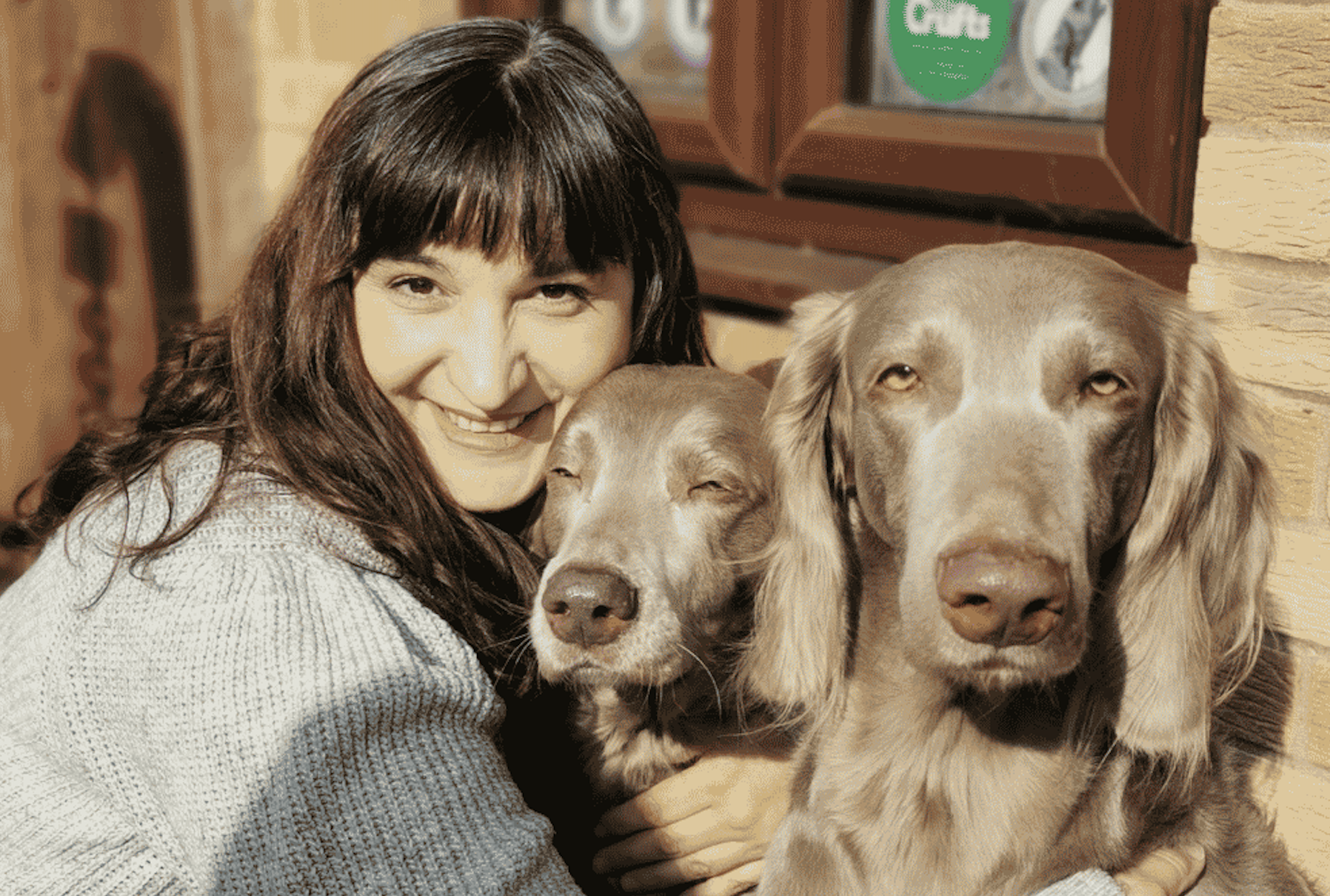
An award-winning dog trainer who says owners’ emotions can have a profound effect on their pets is launching a national awareness day to encourage people to look beyond behaviour and consider how their animals truly feel.
Nina Fotara, 53, is a trainer, behaviourist and Holistic Gundog Specialist who works with dogs and their guardians through Confident Canine, based in Purleigh, Essex.
Her business is built around nervous-system-led training and the principle of “balancing both ends of the lead”, working with both the dog’s emotional state and the energy its guardian brings to the relationship.
Nina is also the founder of the Canine Regulation Project, an industry-wide movement which includes the annual Canine Regulation Day on Monday, September 14.
The initiative aims to start a wider conversation about emotional regulation in dogs and the co-regulation which takes place between animals and the people caring for them.
Nina said: “You are your dog’s environment. A lot of training focuses on the task, such as whether you can get a recall, rather than how it is being taught, what the dog is feeling and what kind of relationship you are building.
“Some owners realise they have an effect on their dog, but they approach that from a place of guilt. I want them to feel empowered by understanding that they can help.”
Nina’s passion for gundogs began when she welcomed her first dog, Kodi, a long-haired Weimaraner, in 2008.
Despite researching the breed and preparing to provide plenty of exercise and mental stimulation, Nina and her daughter Gabriella were shocked by the reality of living with such an intelligent and driven working dog.
Nina said: “As a puppy, I spent a lot of time crying because I was overwhelmed. But when we found the right things for him and gave him somewhere to channel that drive, he became my soulmate dog.
“He was desperate to work, so we did working and shot-over days. We also did showing and he loved agility.
“He taught me to smile again and be happy. His answer to everything was to be silly, and he really opened me back up. I don’t know what I would have done without him.”
That experience helped inspire Confident Canine and taught Nina that working gundogs need far more than simply longer walks.
She said owners who have previously lived with pet spaniels or other gundog breeds can experience a “culture shock” when they take on a dog from working lines.
Nina said: “They think the dog will just need longer walks, but it is nothing to do with that.
“They are normally skiing across the field, hanging on for dear life, while their dog flies around taking everything in and the owner doesn’t even exist for them.
“The step from a gundog to a working gundog is massive.”
Nina believes guardians must find a job which suits the individual animal rather than simply following generic advice about its breed.
She said: “I often ask people whether their gundog is self-employed or employed. Have you given them a job, and is it a job that fits that particular dog?
“Working gundogs have to have an outlet. Asking them to live without one is like asking an artist never to create.
“I love their intelligence and the way they combine that intelligence with incredible sensitivity. They needed that sensitivity to work alongside humans in the field, but it can also make them complicated. I like working with complicated.”
Nina has kept and selectively bred long-haired Weimaraners since 2008. Her dogs have competed and regularly placed in working tests, agility, showing and obedience, as well as working alongside her in the field.
Several have also appeared on set and been filmed and photographed for major brands.
That wide-ranging experience is central to Nina’s approach, allowing her to draw on disciplines beyond traditional gundog training.
Her work has also been shaped by becoming a Reiki Master Teacher in 2006, before she formalised her dog training practice.
She is autistic and has survived domestic violence, giving her personal insight into what it is like to experience a lack of choice, freedom and security.
Those experiences led her to question training methods which may produce a desired behaviour without considering the dog’s nervous system or emotional state.
She said: “A dog might have a very good sit-stay, but is it doing it while feeling awful?
“Sometimes a dog stays because it is so uncomfortable about the situation that it feels unable to move. It has carried out the behaviour, but it hasn’t been helped to feel any better.
“My work is about asking how we can make the dog feel good about what we need from it, as well as looking at where the owner is emotionally, because that has a massive effect.”
Nina’s Regulation First Model™ separates what a dog’s nervous system is experiencing from the behaviour visible on the surface.
She works directly with every client as a sole practitioner, offering in-person support in Essex and online services worldwide.
Guardians are supported through four structured programmes: Steady & Sure for puppies, Calm & Connected, Rapid & Reliable and Freedom & Focus.
Nina recently worked with an owner who had struggled with loose-lead walking despite consulting several trainers.
Instead of focusing solely on the dog, Nina asked the woman to walk in a circle while noticing five things she could see, four she could hear, three she could feel, two she could smell and one she could taste.
Nina said: “At the end, I asked her how it had been and she said, ‘I’m the problem, aren’t I?’
“As soon as she broke that loop of stress and became present, her dog went, ‘Great, I can work with that.’
“When we struggle with things such as reactivity, we tend to hang on tighter. But if we can let go a little and bring our own energy down, it can make such a difference.”
Canine Regulation Day will feature a series of podcast conversations examining regulation from different perspectives, including those of a veterinary behaviourist, a veterinary physiotherapist and Niki French, author of Stop Walking Your Dog.
Nina will also speak to the founder of enrichment business No Fuss Fill on the day itself.
She said: “Sometimes you have to decide not to go for a dog walk or completely rethink what a walk looks like.
“People make a map in their minds and feel they have to complete that route, but it is about quality, not quantity.”
Dog guardians and organisations can visit https://canineregulation.org to download a pledge badge to share as a post, story or profile picture.
Businesses and animal organisations can also access suggested wording to distribute to their mailing lists and supporters.
Nina added: “This year is very much about getting the word out, encouraging people to talk and really think about regulation.
“Everyone I have interviewed so far has admitted that, when I first contacted them, they had to stop and ask themselves what regulation actually meant to them. It has been really interesting.”
Nina also uses and recommends Pet Remedy products to support dogs experiencing overwhelming emotions.
During a recent session, she created a scent exercise for two dogs which were struggling to settle and be separated from one another.
She placed Pet Remedy in the corner of her training area and taught the dogs to seek out the novel scent, marking and rewarding them when they found it.
She said: “They got to take a second to use their noses, which helped bring them down, and were then rewarded at this source of peace and relaxation before returning to work.
“Every time they started to become overwhelmed, we said, ‘Go seek’, and off they went. It worked so well that I am now going to give scent jars to all my programme clients.”
Nina also recommends Pet Remedy for dogs which find travelling in cars difficult, as well as those affected by fireworks or other highly emotional situations.
Her daughter Gabriella, 30, has a sensitive dog called Rosa, who even asks for her Pet Remedy-sprayed bandana when she needs additional support.
Nina said: “She will go over to where the bandanas are kept and show me. When I put hers on, you can see her lift her head as if she is saying, ‘Yes, that’s what I needed.’
“I recommend Pet Remedy for anything involving a big emotion because it can always add something helpful to the mix.”
Alongside the Canine Regulation Project, Nina has created the Holistic Dog® Deck, a collection of cards featuring simple activities guardians can practise with their pets.
Designed for all dogs rather than solely gundogs, the companion deck explores mindfulness, meditation, visualisation, breathwork, movement, sound, somatic techniques and energetic awareness.
Guardians can select a card to give them a shared focus for the day, whether that is moving with their dog in gratitude, exploring helpful soundtracks or using breathwork to create a calmer connection.
Nina said: “The cards contain tools people can actually use with their dogs. They are intended to help owners slow down, become more aware and explore how they and their dogs affect one another.
“Regulation isn’t simply about getting a dog to do what we ask. It is about understanding what that dog is feeling, recognising what we bring to the relationship and helping both ends of the lead feel safe.”
Find out more about Confident Canine at https://confidentcanine.co.uk, the Holistic Dog platform at https://holisticdog.uk and the Holistic Dog Deck at https://holisticdog.uk/deck