
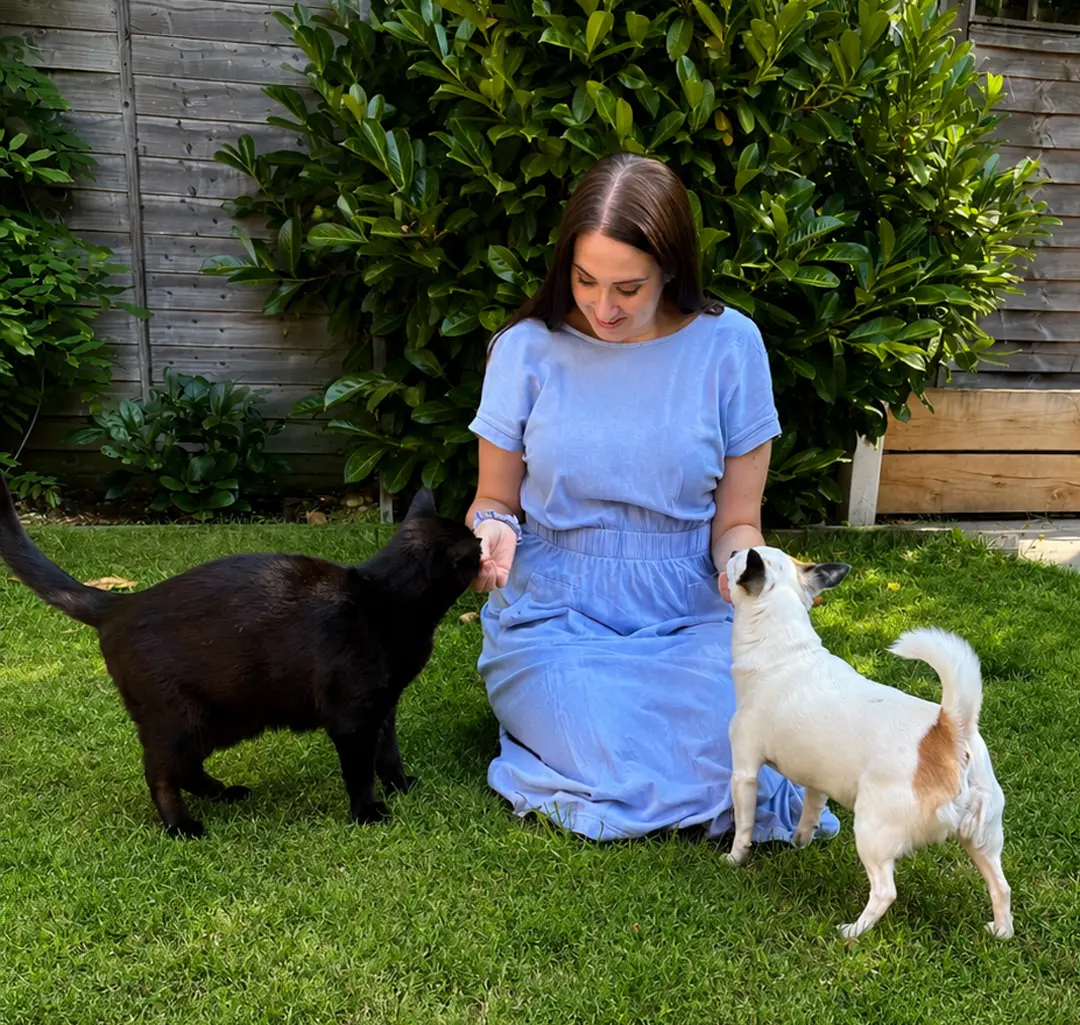
A highly qualified animal behaviourist is offering expert guidance to dog owners through Pet Remedy’s Ask The Professional service.
Laura Blacksedge-Smith, 43, from Maidstone, Kent, has spent many years working in animal welfare and is often the professional people turn to when they find themselves facing a crisis with their pet.
Laura, who is currently launching her local business, Heart Dog Behaviour, has extensive academic qualifications as well as hands-on experience working with animals and their families.
After obtaining a first-class degree in animal management, Laura joined the RSPCA, where she gained frontline experience of animal rescue and welfare.
She later completed a Postgraduate Certificate in Education, enabling her to teach and lecture in animal-related subjects at schools and colleges, including animal science, behaviour and welfare.
Laura then achieved a master’s degree in clinical animal behaviour from the University of Edinburgh before joining Dogs Trust, where she worked in the charity’s post-adoption behavioural support team.
She is also an approved professional with the Kids Around Dogs initiative and delivers courses designed to help children and dogs live together safely and happily.
Laura is now sharing her knowledge through Pet Remedy’s Ask The Professional service, which gives pet owners the opportunity to seek advice from suitably qualified and experienced experts.
She said: “It can be incredibly difficult for dog owners to know where to turn, particularly when they are worried, frightened or dealing with behaviour that appears to be getting worse.
“The world of canine advice can feel like the Wild West. There is so much conflicting information online, and unfortunately not everybody offering advice has the appropriate qualifications or experience.
“One of the most important things about Pet Remedy’s Ask The Professional service is that the person responding will be highly qualified in their field. Owners can feel reassured that they are receiving informed, welfare-led guidance rather than somebody’s opinion or something repeated from social media.”
Among the questions Laura regularly receives are those concerning interactions between dogs and children.
These can range from a child who is nervous around dogs following a negative or frightening encounter to a deeply ingrained fear learned from a parent, close relative or another influential adult.
Laura says that fear can also affect the behaviour of the dog. When the signals being shown by either the child or animal are misunderstood, the consequences can sometimes be upsetting or dangerous.
She said: “Children and dogs can have wonderful relationships, but we should never assume that either of them automatically knows how to behave around the other.
“A frightened child may run, scream, stare at the dog or make sudden movements. The dog may then become worried, excited or defensive in response. If those reactions are misinterpreted as a game or threat, the situation can quickly escalate.
“It is important to look at what both the child and the dog are communicating and to address the underlying fear, rather than forcing an interaction in the hope that they will simply get used to one another.”
Neurodivergent children can also experience particular challenges around dogs. These may relate to unpredictable movement or behaviour, barking and other noises, or sensory issues involving the animal’s smell or the texture of its coat.
However, Laura stresses that the welfare and emotional needs of the dog must remain at the heart of every interaction.
If a dog’s early signs of discomfort are repeatedly overlooked and the animal is pushed beyond what it can tolerate, it may eventually growl, snap or bite.
Laura said: “Supporting a child must never mean ignoring the dog’s needs or putting the animal into a situation it cannot cope with.
“Dogs communicate discomfort long before they bite, but some of those signs can be extremely subtle. Turning the head away, licking the lips, yawning, becoming very still or attempting to leave may all indicate that a dog needs space.
“A growl should never be punished because it is valuable communication. It is the dog telling us that it is uncomfortable and needs the situation to change. If we suppress that warning without addressing the cause, the dog may feel it has no option but to react more strongly next time.
“The safest and kindest relationships are built when adults actively supervise, respect the dog’s boundaries and help children understand that an animal is not a toy.”
Laura’s top five tips for keeping children and dogs safe and happy
1. Create a calm, reassuring environment. Use a Pet Remedy plug-in in the rooms where the dog spends most of its time. Pet Remedy’s calming formulation can help the animal feel safe and settled, particularly in a busy household or during periods of change.
2. Give your dog somewhere to just be a dog. Every dog needs a quiet place where they can rest without being disturbed. Whether it is a bed, crate or cosy corner, teach children that when the dog is there, they are having some downtime. Just like us, dogs need time to relax and recharge.
3. Supervise every interaction, and I mean really supervise. It is easy to get distracted, but young children and dogs should never be left together without an adult actively watching. That way, you can step in if either your child or your dog needs a little more space, helping both to have positive experiences together.
4. Learn your dog’s body language. Dogs are talking to us all the time, just not with words. Lip licking, yawning, turning away, moving away or suddenly becoming very still can all be signs that they are feeling uncomfortable. Spotting those early signals means you can step in before your dog feels the need to shout louder.
5. Remember my simple rule: ‘No faces near faces.’ Even the friendliest family dog can feel uncomfortable if a child puts their face close to theirs. Encourage children to let dogs choose whether they want to interact, use gentle hands and calm voices, and always give them space when they are eating, sleeping or resting. If your child does put their face near your dog, call your dog away from the interaction.